About the Journal
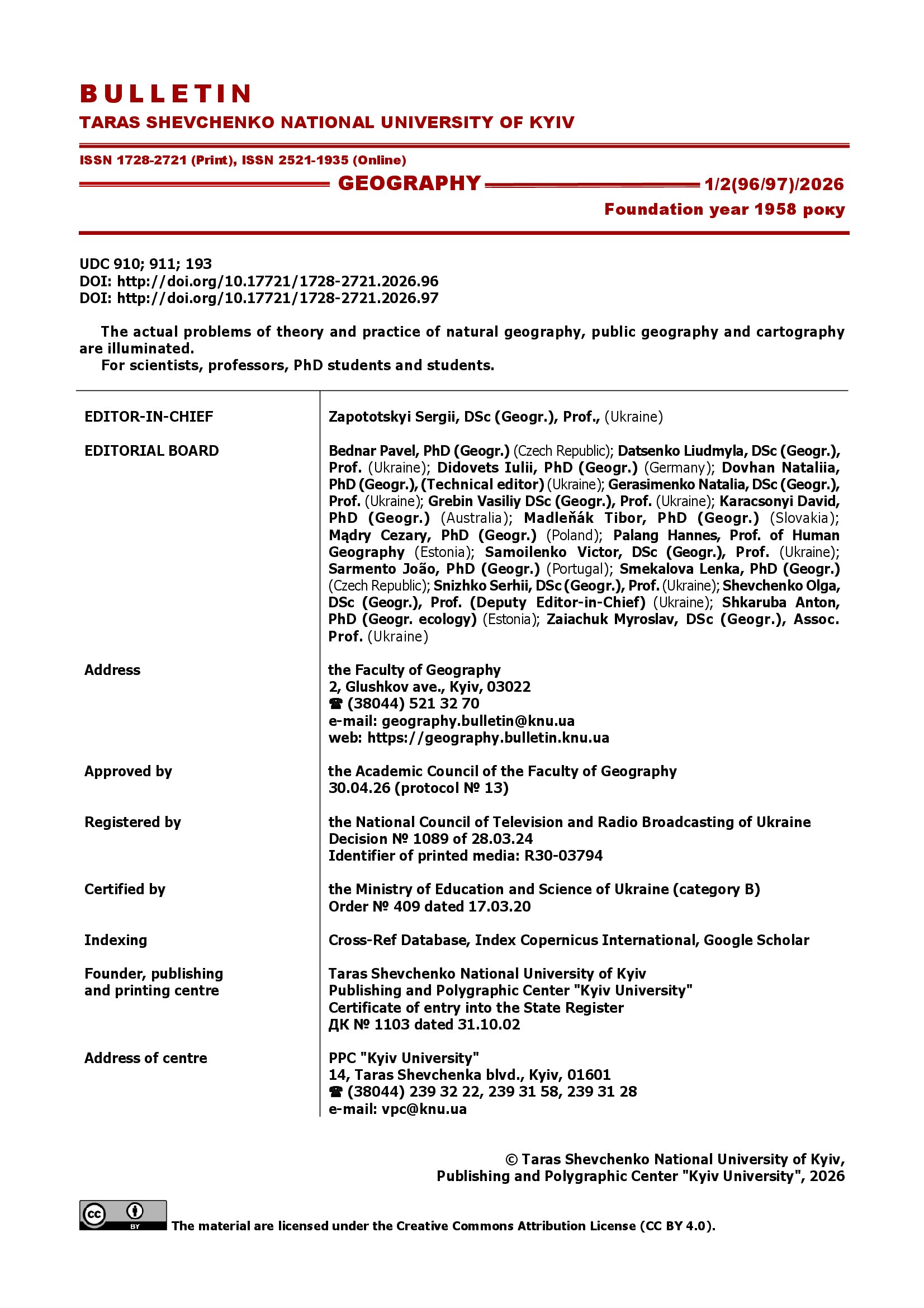
"Bulletin of Taras Shevchenko National University of Kyiv. Geography" is a peer-reviewed open-access academic journal that publishes research on contemporary issues in physical and human geography, cartography, regional studies, and related interdisciplinary fields. The journal presents theoretical and applied contributions to geographical science and also includes review articles and book reviews on significant works in geography.
ISSN 1728-2721; eISSN 2521-1935
Publisher DOI: https://doi.org/10.17721
Journal DOI: https://doi.org/10.17721/1728-2721
Scientific profile of the publication: Human Capital Development, Social Sciences, and Journalism.
The magazine is included in the list of scientific subject area journals of Ukraine (category B):
- in the speciality 103 – Earth Sciences, 106 – Geography, 193 – Geodesy and Land Management (Order of the Ministry of Education and Culture No. 409 of March 17, 2020).
- in the speciality C6 – Geography and Regional Studies (Order of the Ministry of Education and Culture No. 928 of June 11, 2026).
Registered: The National Сouncil of Television and Radio Broadcasting of Ukraine. Media ID R30-03794 (Decision No. 1089 of March 28, 2024).
Founder-publisher: Taras Shevchenko National University of Kyiv
Unified State Register of Enterprises and Organizations of Ukraine (EDRPOU) code 02070944
Year of foundation: 1958
Publication languages: Ukrainian, English
Periodicity: 4 times per year
Current Issue
2026: Bulletin of Taras Shevchenko National University of Kyiv. Geography. Issue 1/2 (96/97)
This issue of the scientific journal contains a series of comprehensive papers covering methodological, natural-geographic, and socio-geographic aspects of modernity. The publication opens with an analysis of the historical approach as a fundamental principle of natural sciences, which ensures a holistic understanding of the evolution of natural systems, and is complemented by a study of Romania's hydrography, focusing on the state of water resources and their modern institutional management structure. The scientific discourse continues with a spatiotemporal analysis of cold spells in Ukraine, confirming the impact of global warming on regional climate trends, as well as a conceptual substantiation for identifying the forest-field structure as the foundation of the economic potential of Ukraine's lowland regions. Furthermore, the authors explore the potential of tourism and recreational activities as a tool for non-formal youth education, proposing a model that combines research and social components. A significant place in this issue is occupied by an analysis of the transformation of Ukraine’s geopolitical status, substantiating its role as a multifunctional strategic hub and a key pivot of the European and Eurasian geospace, integrating security, logistics, and innovation functions amid global challenges. The issue concludes with a study on the spatial patterns of mined areas worldwide, emphasizing the importance of integrating cartographic and geoinformation technologies into humanitarian demining systems to ensure the sustainable development of post-conflict regions.
Published:
2026-05-30


